|
||
47. Troilite daubreelite nodules |
| Listing of Structures |
| Back...Next |
| Meteorite - Nordheim, ungrouped iron, ataxitic |
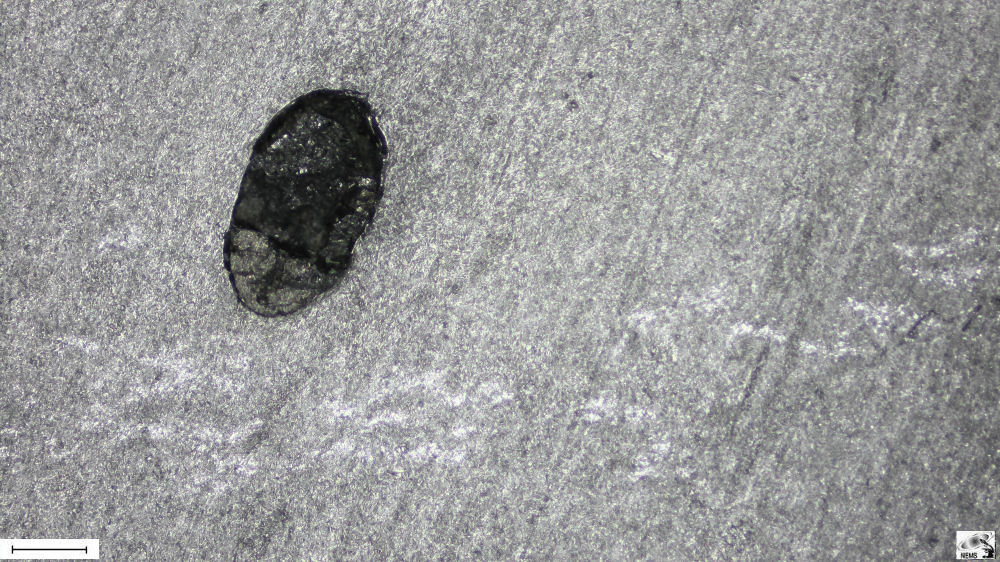
| Figure 1. Scale bar 400 µm. |
| Meteorite: Nordheim, ungrouped iron, ataxitic |
| Troilite/daubreelite nodule. |
Figure 1. Troilite-daubreelite nodule in the Nordheim ungrouped ataxitic iron. Scale bar=400 µm. Additional figures (200–400 µm scale bars): Further examples of troilite-daubreelite nodules in Nordheim, highlighting daubreelite exsolution textures. Troilite (FeS) is a ubiquitous sulfide mineral in iron meteorites, typically occurring as rounded to lens-shaped nodules or blebs. In the Nordheim ungrouped ataxitic iron (Ni ˜ 11.67 wt%), troilite forms dispersed nodules 1–10 mm across. Closely associated with troilite is daubreelite (FeCr2S4), a chromium-bearing cubic sulfide that commonly exsolves from troilite during cooling. In Nordheim, daubreelite constitutes roughly 10–20% of many nodules, appearing as oriented, bar-like or lamellar inclusions 5–500 µm wide. These bars frequently extend slightly beyond the troilite margins, producing a distinctive protruding texture. Mineralogy and Textural Relationships Troilite and daubreelite co-precipitate from a residual sulfide melt that becomes immiscible during the late stages of metallic core crystallization. Upon cooling, daubreelite exsolves from troilite as oriented lamellae or bars, often aligned with crystallographic planes (parallel to {0001} of troilite). This exsolution reflects the limited solid solution between the two phases at lower temperatures and the partitioning of chromium into the daubreelite structure. The protruding daubreelite bars in Nordheim likely result from differential contraction, preferential polishing relief, or continued growth during subsolidus annealing. Ataxitic irons like Nordheim lack a well-developed Widmanstätten pattern due to high nickel content and rapid cooling or shock history, yet they preserve these sulfide nodules as primary igneous features modified by parent-body cooling. Similar troilite-daubreelite associations occur across iron groups, including hexahedrites (lower-Ni) and other ungrouped irons, though nodule size, abundance, and exsolution textures vary with bulk composition and cooling rate. Petrogenetic and Cosmochemical Significance Sulfide nodules record the fractionation of sulfur (and chalcophile elements) during core crystallization. Troilite-daubreelite assemblages are particularly useful for: • Constraining oxygen fugacity and sulfur content of the parent melt • Estimating cooling rates through exsolution kinetics • Tracing shock or reheating events, which can mobilize or recrystallize sulfides. In ungrouped ataxites such as Nordheim, these features help place the meteorite within the broader spectrum of differentiated planetesimal cores, highlighting chemical diversity beyond the major iron groups. Associated minerals (e.g., schreibersite, graphite, or silicates in some nodules) provide additional insights into late-stage melt evolution. These nodules exemplify primary high-temperature differentiation products that survive as accessory phases in the metallic matrix, contrasting with secondary terrestrial weathering products (e.g., iron oxides or hydroxides replacing sulfides). |
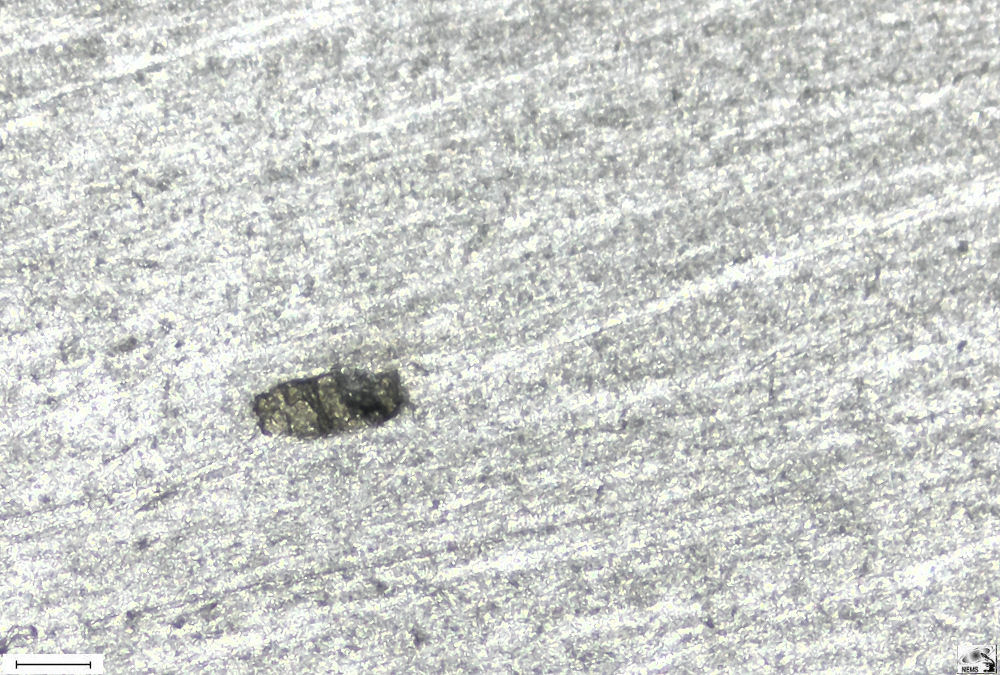
| Figure 2. Scale bar 200 µm. |
| Meteorite: Nordheim, ungrouped iron, ataxitic |
| Troilite/daubreelite nodule. |
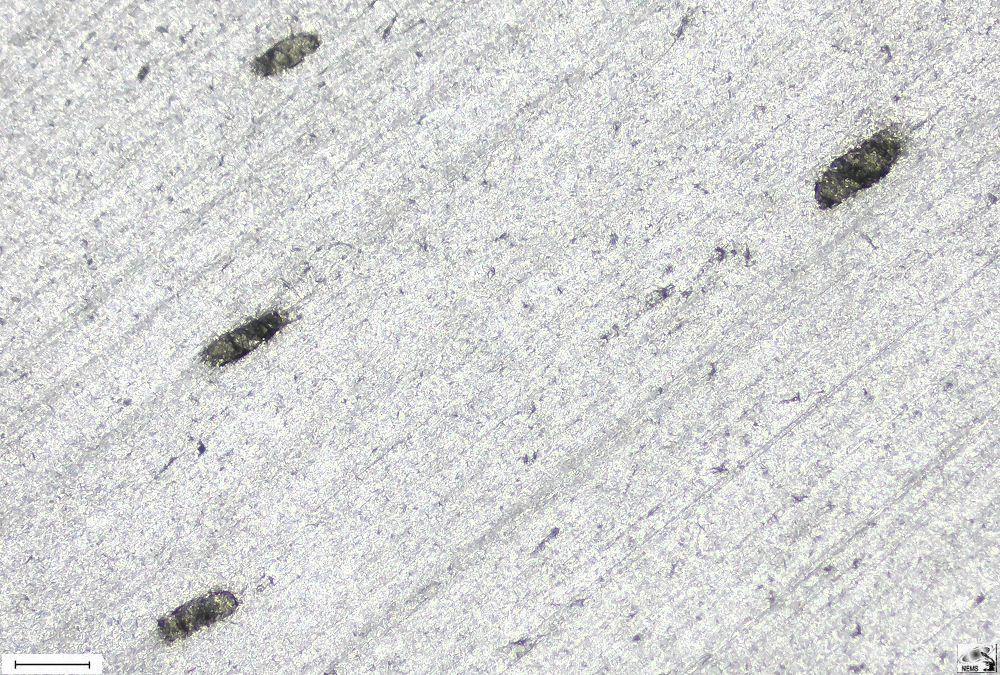
| Figure 3. Scale bar 400 µm. |
| Meteorite: Nordheim, ungrouped iron, ataxitic |
| Troilite/daubreelite nodule. |
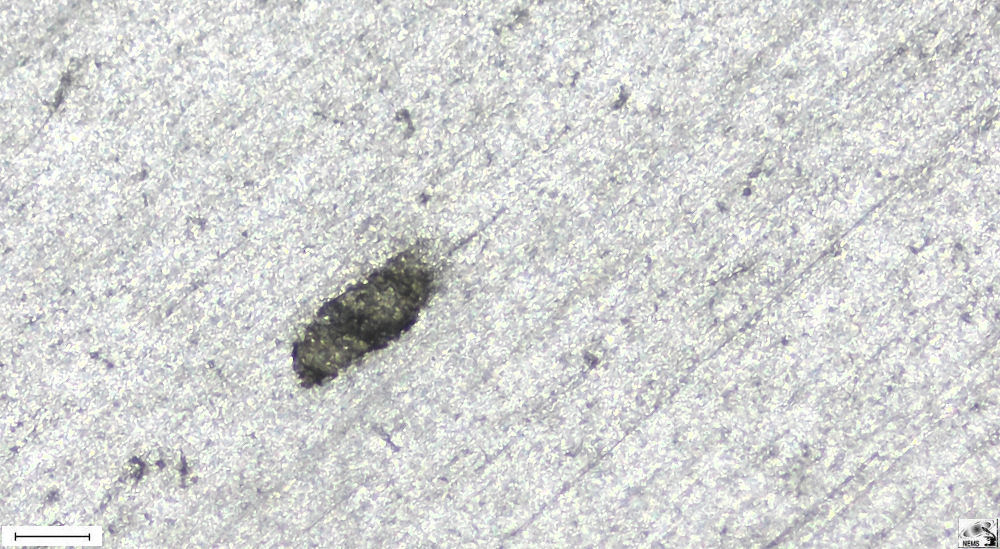
| Figure 4. Scale bar 250 µm. |
| Meteorite: Nordheim, ungrouped iron, ataxitic |
| Troilite/daubreelite nodule. |
| References • Buchwald, V. F. (1975). Handbook of Iron Meteorites. University of California Press. (Comprehensive descriptions of sulfide occurrences). • Keil, K. (1968). Mineralogical and chemical relationships among enstatite chondrites and related meteorites. Journal of Geophysical Research. (Broader context of sulfides). • Meteoritical Bulletin Database: Nordheim (ungrouped iron). • Rubin, A. E. (various works on iron meteorite mineralogy). • Ulff-Møller, F., et al. (studies on sulfide nodules in irons). • Handbook of Mineralogy: Daubréelite (FeCr2S4) entry. Note: This section integrates well with prior discussions of schreibersite/rhabdite and other opaque phases described in meteoritestructures.org. |
| Listing of Structures |